Make a Christmas matching card game from your own photos
Grandad, the dog in its jumper, a mince pie and the wonky star off the tree – all on round cards, where any two cards share exactly one picture. Find it first and shout it out. Start from our Christmas symbols, swap in your photos, and print the deck at home tonight.
Start with Christmas symbols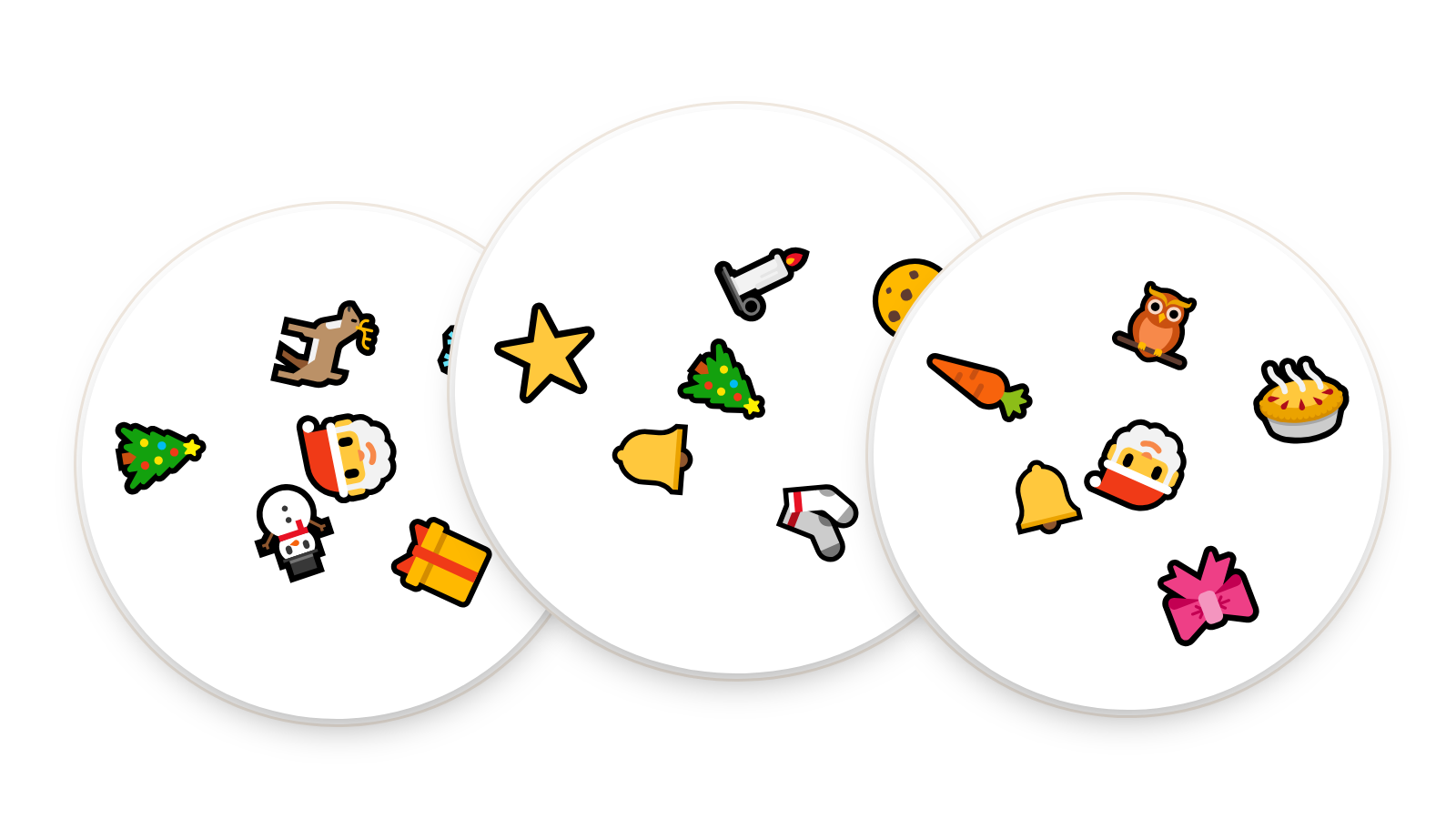
Why a homemade card game works at Christmas
Most Christmas games need a quizmaster, a pen or a lot of explaining. This one needs a deck of cards and about ten seconds of rules: turn over two cards, find the one picture they have in common, say it out loud. Four-year-olds and grandparents play on equal terms, and a round is over before the gravy goes cold.
When the pictures are your own people and your own in-jokes, the game stops being a stocking filler and becomes the thing everyone talks about. Nobody has ever shouted “Auntie Sue!” at a shop-bought deck.
Three ways to use it
- As a present: a deck of grandchildren’s faces for Nana and Grandad, or a family deck to tuck into a Christmas Eve box. Print it, punch the circles and wrap it in a tin or a little box.
- On the day: deal it out between lunch and the King’s speech, at the table while the pudding is warming, or on Boxing Day when the cousins come round.
- At the party: an office or school Christmas party deck with colleagues’ faces, the team mascot and in-jokes from the year. A quick, quiet game for a Secret Santa table.
How to make it
- 1
Open the editor with Christmas symbols
The button on this page loads 57 festive symbols into a 55-card deck. Want something smaller? Choose 13 cards (free) or 31 cards in the editor.
- 2
Swap in your photos
Drag in photos of family, pets and favourite things to replace any symbol. One click removes the background, so a face or a dog sits neatly on the card.
- 3
Arrange the cards
The deck is worked out for you: any two cards always share exactly one symbol. Resize and rotate pictures, or swap them between cards, until it looks right.
- 4
Pick a card back
Choose a Christmas red or green, a gradient, or upload your own picture – a family photo from last year works well.
- 5
Download and print
Download a print-ready PDF for A4 or US Letter paper and print at home or at a print shop. Nothing is posted, so there are no last-posting dates to worry about.
Christmas symbol ideas
Pick pictures that look different from each other at a glance: different shapes and colours are easier to spot than five shades of red.
- Christmas tree
- Father Christmas
- Reindeer
- Snowman
- Robin
- Holly
- Mistletoe
- Christmas pudding
- Mince pie
- Pigs in blankets
- Brussels sprout
- Roast turkey
- Christmas cracker
- Paper crown
- Stocking
- Bauble
- Candy cane
- Gingerbread man
- Bell
- Star
- Angel
- Candle
- Wreath
- Sleigh
- Snowflake
- Penguin
- Polar bear
- Present
- Advent calendar
- Satsuma
- Carrot for the reindeer
- Hot chocolate
- Fairy lights
- Snow globe
- Christmas jumper
- Mittens
- Nutcracker
- Elf
- Chimney
- Nativity donkey
Photo ideas
Faces are the most fun, but small faces start to look alike. Mix them with objects and pets in strong colours, and crop close so each picture fills its circle.
- Every grandchild, one photo each
- Nana and Grandad (in paper crowns, ideally)
- The dog or cat in a Christmas jumper
- Baby’s first Christmas
- Your front door with the wreath on
- The tree topper that has survived thirty Christmases
- Children’s drawings of Father Christmas, photographed flat
- A favourite toy or teddy
- Last year’s Christmas dinner
- Family in-jokes: the burnt roast potatoes, Dad’s terrible hat
Christmas ways to play
The core rule never changes: find the one picture two cards share and name it first. These variations fit around a British Christmas.
Cracker pull
Two players each hold a card face down and turn them over together, like pulling a cracker. Whoever names the match first keeps both cards; the loser reads out the next cracker joke.
Empty the stocking
Deal all the cards out, one face-up card in the middle. Match your top card to the middle card, name the picture and put your card on top. First to empty their pile wins.
Snowball
Each player gets one face-up card; the rest go in the middle. Spot a match between your card and the top of the pile, name it, take the card. The biggest snowball at the end wins.
Boxing Day knockout
One-on-one rounds of Cracker pull in a knockout draw, with the cousins, the in-laws and anyone else who stayed over. The champion gets the last chocolate in the tin.
Advent countdown
With a 31-card deck, set aside 24 cards. Each morning in December, turn over a new card and find its match with yesterday’s card before breakfast.
Little ones’ rules
No speed, no scoring: turn two cards over and take turns to find and name the match. The 13-card deck has four pictures per card, which suits small hands and short attention spans.
Printing your deck
Choose the deck size by who is playing. 13 cards with 4 pictures each is a gentle game for young children and a free way to try it. 31 cards with 6 pictures each is a good family deck. 55 or 57 cards with 8 pictures each is the full-size game; 55 is the usual count in boxed matching games and leaves the two spare cards out.
Each deck downloads as a PDF laid out for A4 or US Letter paper, ready to print at home or at a print shop.
- Paper: 300 gsm card stock is sturdy enough to shuffle; matt card hides fingerprints better than gloss.
- Size: cards are round and you set the diameter in the editor, from 40 to 100 mm. 85 mm is the size of the best-known matching games.
- Cutting: a circle paper punch in your card size gives clean edges in seconds. Scissors are fine for a 13-card deck.
- Double-sided: each page of card backs follows its page of fronts, mirrored for printing on both sides. Print the single test card first to check your printer lines them up.
- In a hurry? A local print shop can print and cut a PDF the same day.
MatchedCards compared with Dobble and Spot It!
If your family loves Dobble or Spot It!, a deck of your own plays the same way: any two cards share exactly one picture. Here is what is different.
| MatchedCards | Dobble and Spot It! | |
|---|---|---|
| Pictures | Your photos, drawings and any symbols you choose | The illustrations printed by the publisher |
| Number of cards | 13, 31, 55 or 57 | 55 in the standard game |
| Format | A PDF you print and cut yourself | A printed boxed game |
| Getting it | Download straight away, no delivery | From a shop or by post |
| Price | Free for 13 cards, from $6.20 for larger decks | Retail price of the boxed game |
Start your Christmas deck
The editor opens with 57 Christmas symbols ready to go. Swap in your photos, download the PDF and print it tonight.
Start with Christmas symbolsQuestions
How much does it cost?
A 13-card deck is free. Bigger decks are a one-time payment: $6.20 for 31 cards, $11.00 for 55 cards and $11.40 for 57 cards. You only pay when you download a deck larger than 13 cards.
Will it be ready in time for Christmas?
Yes. Nothing is printed or posted by us: you download a PDF as soon as the deck is finished and print it yourself, even on Christmas Eve.
How many photos do I need?
A 13-card deck uses 13 pictures, a 31-card deck uses 31, and the 55- and 57-card decks use 57. Start from the Christmas symbols and replace as many as you like with photos: five faces among festive symbols works as well as a deck of photos only.
Can young children play?
Yes. The 13-card deck has four pictures per card, and you can play without a time limit (see Little ones’ rules above). Pictures of people they know make it easier, not harder.
What paper should I use, and how do I cut round cards?
Use 300 gsm card stock and a circle paper punch in the same diameter as your cards. The editor lets you set the size from 40 to 100 mm.
Can I make a deck for an office Christmas party?
Yes. Use photos of the team, the office, the kettle that never works – but ask colleagues before you print their faces. You can use the decks you create as you like, as long as you have the rights to the photos.
Is this the official Dobble or Spot It! game?
No. MatchedCards is an independent alternative to Dobble and Spot It!: it uses the same kind of matching mechanic, but the deck, the pictures and the rules variations here are your own.
Dobble and Spot It! are trademarks of Asmodee Group. MatchedCards is not affiliated with or endorsed by Asmodee.