A gift for grandparents from the grandchildren: a card game of your family photos
Every grandchild’s face, the house, the dog, Grandad’s allotment and Nan’s cake tin – all on round cards, where any two cards share exactly one picture. Find it first and say it out loud. Start from our family symbols, swap in your photos, and print the deck at home: nothing to post, so it is ready for Christmas even if you start on Christmas Eve.
Start with family symbols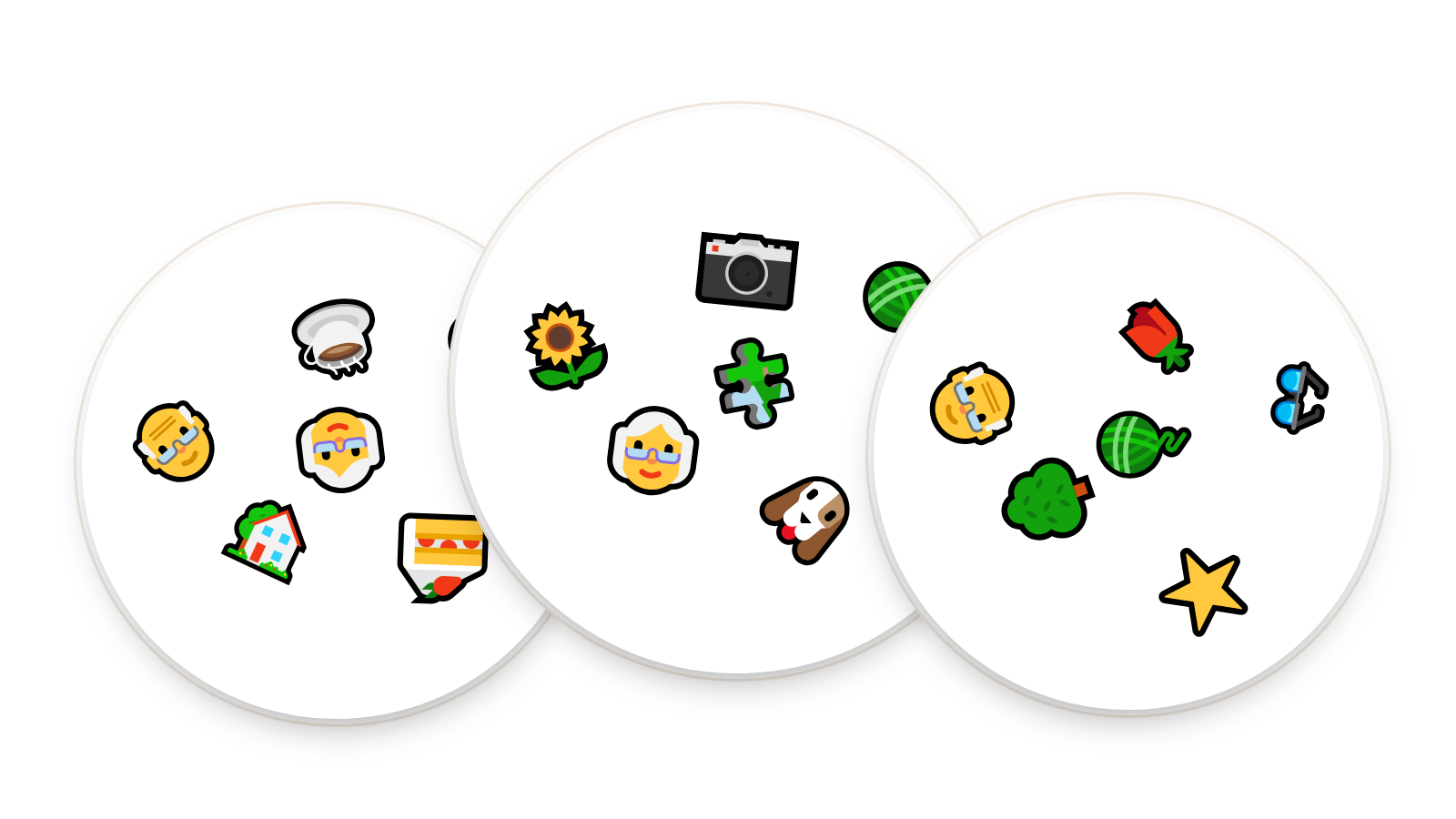
Why a card game of family photos makes a good present
Grandparents who have everything rarely want another thing for the shelf. A photo album gets looked at once and a calendar runs out in a year. A deck of cards made from the family’s own photos gets looked at every time it is played – and it is played together, which is usually what grandparents want most from a visit.
The rules take ten seconds: turn over two cards, find the one picture they share, name it first. Small grandchildren and grandparents play on equal terms, and there is always a story behind the pictures: “that was the summer the tent blew away”.
Four ways to give it
- For Christmas, from the grandchildren: they choose the photos, draw a few pictures of their own and help punch out the cards. A homemade gift for grandparents that the children really did make, wrapped and under the tree on Christmas morning.
- From the grown-up children: photos from across the family’s life – Nan and Grandad’s wedding, the first house, every baby in turn, the holidays everyone still talks about. A personalised present for parents who say they don’t need anything.
- For grandparents who live far away: make the deck together on a video call, then email the PDF so someone near them can print it. Next time you visit, the cards are already there waiting.
- For the family get-together: bring it out on Boxing Day, at a big birthday or at Grandparents Day, when three generations are round one table and need a game everyone can join.
If Nan or Grandad finds small pictures hard to see
Choose the 13-card deck: each card has 4 pictures, so every picture is big and the game is slower and calmer. Use close-up photos with one clear subject each, set a large card size in the editor, and pick a plain light card back. In a care home or at a quiet visit, it works just as well without any scoring: turn over two cards and talk about the pictures.
How to make it
- 1
Open the editor with family symbols
The button on this page loads 57 family symbols – Nan, Grandad, a baby, home, a cup of tea, cake, knitting, the garden and the dog – into a 55-card deck. For small children or larger pictures, choose 13 cards (free) or 31 cards in the editor.
- 2
Swap in your photos
Drag in photos of the grandchildren, the grandparents, pets and favourite places to replace any symbol. One click removes the background, so a face or a dog sits neatly on the card. Scanned children’s drawings and old printed photos work too.
- 3
Arrange the cards
The deck is worked out for you: any two cards always share exactly one picture. Resize and rotate pictures, or swap them between cards, until it looks right.
- 4
Pick a card back
Use a colour, a gradient, or upload your own picture – a family photo, the grandchildren’s handwriting or “To Nan and Grandad, love from all of us”.
- 5
Download and print
Download a print-ready PDF for A4 or US Letter paper and print at home or at a print shop. Nothing is posted, so there is no last posting date to worry about before Christmas.
Symbol ideas for a family deck
Pick pictures that look different from each other at a glance: a teapot, a sunflower and a ball of wool are easier to tell apart than five garden flowers.
- Nan
- Grandad
- Baby
- Their house
- Cup of tea
- Slice of cake
- Ball of wool
- Sunflower
- Dog
- Jigsaw piece
- Camera
- Tree in the garden
- Heart
- Cat
- Biscuit
- Apple pie
- Rose
- Apple
- Garden bird
- Dice for games night
- Books
- Reading glasses
- Teddy bear
- Fishing rod
- Steam train
- Rainbow
- Strawberry
- Butterfly
- Honey pot
- Bicycle
- Christmas tree
- Present
- Candle
- Woolly gloves
- Umbrella
- Loaf of bread
- Carrot from the allotment
- Tomato plant
- Hedgehog
- Radio
- Piano
- Letter in the post
- Ice cream at the seaside
- Tent
- Old car
- Football
- Sheep
- Moon and stars
Photo ideas
Faces are the most fun, but baby photos start to look alike. Mix them with objects, pets and places in strong colours, and crop close so each picture fills its circle – especially if the grandparents prefer bigger pictures.
- Each grandchild on their own, as a baby and now
- Nan and Grandad on their wedding day, and young, before any of you were born
- Their own parents, brothers and sisters – a photo from the family album
- The family pets, past and present
- The grandchildren’s drawings of Nan and Grandad – scan them or photograph them flat
- Their favourite things: the garden, the allotment, the shed, the knitting basket, the cake tin
- Places that matter: their house, the street they grew up in, the caravan, the beach you always go to
- Family holidays and big days: weddings, christenings, graduations
- Famous dishes: Sunday roast, the Christmas pudding, the jam they make every summer
- Little things only your family would get: a catchphrase, Grandad’s hat, a running joke
Ways to play with Nan and Grandad
The core rule never changes: find the one picture two cards share and name it first. These variations fit three generations round one table.
Christmas crackers
Before Christmas dinner, tuck one card into each cracker. After the bang, everyone compares cards with their neighbour: the first to name the shared picture reads out the joke.
Boxing Day tournament
Grandparents against grandchildren. Both sides turn over a card at the same time; first to name the match wins the round. Best of five, then swap the players. The losing team makes the tea.
Tell me about this one
For a deck of family photos: when you name a match that is a photo, you also say who is in it or where it was taken – or ask Nan or Grandad to tell the story. No speed, no scoring, as long as the stories last.
Pile up
Deal all the cards out, one face-up card in the middle. Match your top card to the middle card, name the picture and put your card on top. First to empty their pile wins.
Slow and steady
Turn two cards over and take turns to find the match – no racing, everyone gets their go. With the 13-card deck and its four big pictures per card, it suits a toddler on Nan’s knee and anyone who prefers a calmer game.
Across the miles
Both households print the same PDF. On a video call, one person holds up a card to the camera and the other turns over one of theirs; whoever names the shared picture first keeps both.
Printing your deck
Choose the deck size by who is playing. 13 cards with 4 pictures each suits small children and anyone who likes big pictures, and is a free way to try it. 31 cards with 6 pictures each is a good family deck. 55 or 57 cards with 8 pictures each is the full-size game for older children and adults; 55 is the usual count in boxed matching games and leaves the two spare cards out.
Each deck downloads as a PDF laid out for A4 or US Letter paper, ready to print at home or at a print shop. Once you have the PDF, print as many decks as you need – one for each set of grandparents is fine.
- Timing: there is no delivery, so you can make it the week before Christmas. In the US, Grandparents Day falls on 12 September 2027.
- Paper: 300 gsm card stock is sturdy enough to shuffle; matt card hides fingerprints and is easier on the eyes than gloss.
- Size: cards are round and you set the diameter in the editor, from 40 to 100 mm. 85 mm is the size of the best-known matching games; 90–100 mm gives bigger pictures for older eyes.
- Cutting: a circle paper punch in your card size gives clean edges in seconds, and grandchildren can do the punching.
- Double-sided: each page of card backs follows its page of fronts, mirrored for printing on both sides. Print the single test card first to check your printer lines them up.
- Wrapping: a small tin, a kraft box tied with ribbon, or in a Christmas stocking with a note from each grandchild.
MatchedCards compared with Dobble and Spot It!
If your family has played Dobble or Spot It!, a deck of your own plays the same way: any two cards share exactly one picture. Here is what is different.
| MatchedCards | Dobble and Spot It! | |
|---|---|---|
| Pictures | Your family photos, children’s drawings and any symbols you choose | The illustrations printed by the publisher |
| Number of cards | 13, 31, 55 or 57 | 55 in the standard game |
| Picture size | 4, 6 or 8 pictures per card, card size up to 100 mm | 8 pictures per card |
| Format | A PDF you print and cut yourself | A printed boxed game |
| Price | Free for 13 cards, from $6.20 for larger decks | Retail price of the boxed game |
Start your family deck
The editor opens with 57 family symbols ready to go. Swap in your photos, download the PDF and print it at home – in time for Christmas, with nothing to post.
Start with family symbolsQuestions
How much does it cost?
A 13-card deck is free. Bigger decks are a one-time payment: $6.20 for 31 cards, $11.00 for 55 cards and $11.40 for 57 cards. You only pay when you download a deck larger than 13 cards.
Do you post the cards?
No. You get a PDF and print it yourself, at home or at a print shop, then cut out the cards. That means no posting dates before Christmas – and you can print another copy whenever a card goes missing.
Can the grandchildren make it themselves?
With a grown-up at the computer, yes. Children can choose the photos, draw pictures to scan in, pick the card back and punch out the cards. From about four they can play the 13-card deck; from six or seven, the 31-card deck.
Is it suitable for grandparents with poor eyesight?
Choose the 13-card deck with 4 pictures per card, set a large card size (up to 100 mm), and use close-up photos with one clear subject. Matt card and a light card back help too. You can also play without any racing.
Our grandparents live far away. How do we give it?
Make the deck, download the PDF and email it to someone near them who can print it, or print two copies and play over a video call. The PDF can be printed as many times as you like.
How many photos do I need?
A 13-card deck uses 13 pictures, a 31-card deck uses 31, and the 55- and 57-card decks use 57. Start from the family symbols and replace as many as you like with photos: a dozen family faces among teapots and cake works as well as a deck of photos only.
Is this the official Dobble or Spot It! game?
No. MatchedCards is an independent alternative to Dobble and Spot It!: it uses the same kind of matching mechanic, but the deck, the pictures and the rules variations here are your own.
Dobble and Spot It! are trademarks of Asmodee Group. MatchedCards is not affiliated with or endorsed by Asmodee.