A speech therapy card game made from your own pictures
Every two cards share exactly one picture: find it and say it out loud. Put the child’s target words on the cards – a sock, a sun, a sandwich – and each round of the game is another chance to say one of them. Start from our everyday pictures, swap in your own, download a PDF and print it. Made for speech and language therapists (SLTs, or SLPs in the US) who make their own materials, and for parents whose therapist has given them practice to do at home.
Start with everyday pictures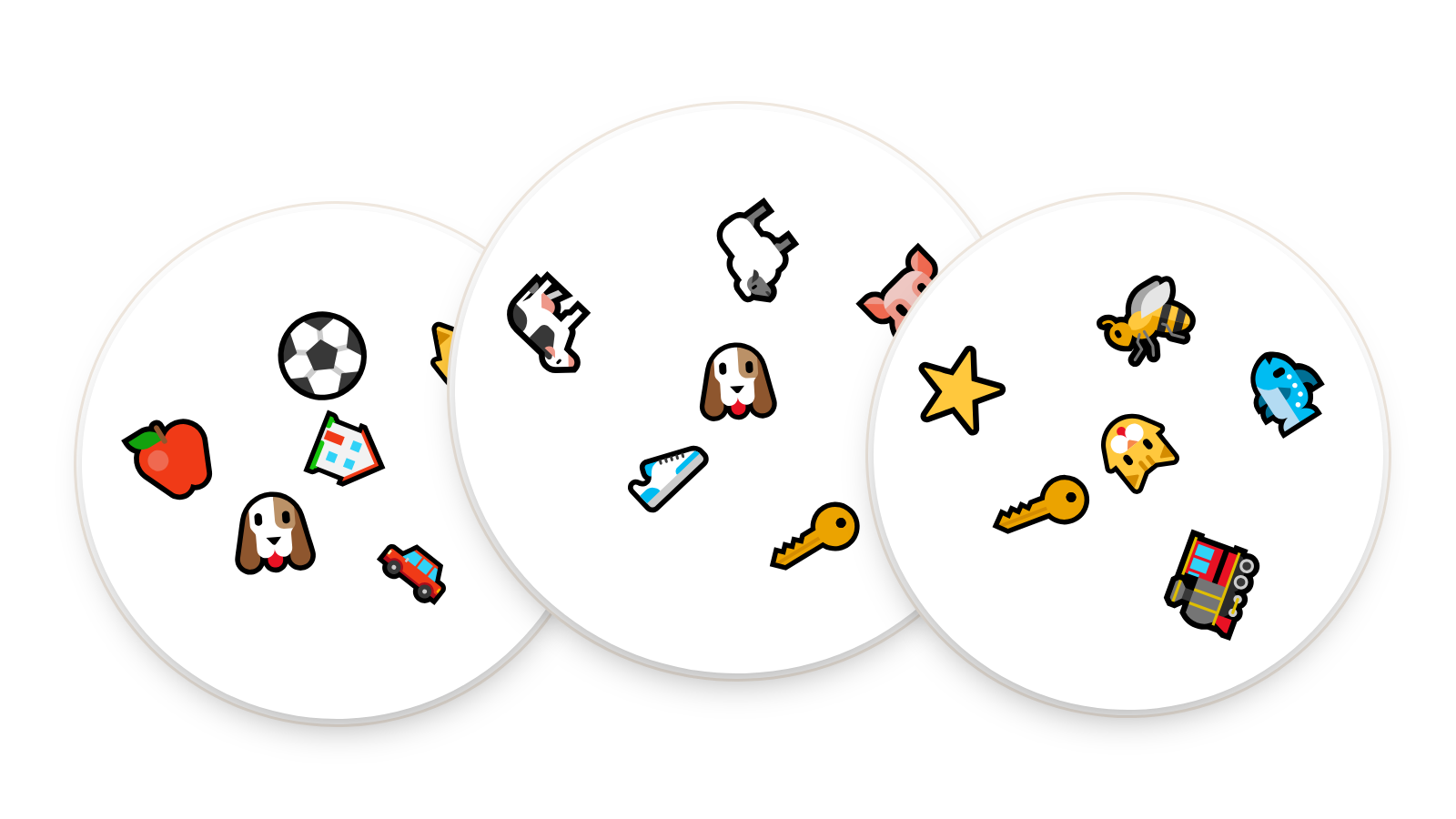
Why a matching card game for sessions and home practice
Turn over two cards, find the one picture they share, name it. That is the whole game, so children pick it up in a minute and want another round. Every round ends with someone saying a word – and if the pictures are the words a child is working on, the game asks for those words again and again without feeling like a worksheet.
The deck is yours to fill. The therapist chooses the targets and the way they are practised; the game is only the material. You can make a new deck for each child, each sound or each set of words, and print it as often as you need.
Three ways to use it
- A deck for the child’s target sound: the therapist or the parent collects pictures of words with that sound – photos of real objects work well – and builds a deck from them. When the target words change, make another deck from the next list.
- A deck from the child’s own life: photos of their toys, their pet, their shoes, their lunchbox, the family and the people they see every week. The child names the match, and finding their own dog or their own wellies on a card is half the fun.
- A game for group sessions: two to six children around one deck, each naming the match before they take a card. The rules below include calm versions without speed, so the quieter children get their turn too.
How to make it
- 1
Open the editor with everyday pictures
The button on this page loads 31 simple pictures – dog, cat, apple, car, ball, bus, shoe and more – into a 31-card deck with 6 pictures per card. For younger children, choose 13 cards (free, 4 pictures per card) in the editor; for older children, 55 or 57 cards with 8 pictures each.
- 2
Swap in the target words
Drag in photos or pictures of the words the child is working on to replace any symbol. One click removes the background, so a photo of a sock or a toy sits neatly on the card. Any symbol is a picture you upload, so a photo of one of your existing picture cards works too.
- 3
Check the cards
The deck is worked out for you: any two cards always share exactly one picture. Resize, rotate or swap pictures between cards until each one is easy to recognise.
- 4
Pick a card back
A plain colour, a gradient, or your own picture – the child’s name, a drawing, or a colour per deck so the decks for different sounds don’t get mixed up.
- 5
Download and print
Download a print-ready PDF for A4 or US Letter paper, print it, cut out the round cards and the deck is ready for the next session or for practice at home.
Picture ideas: everyday things to name
Simple, familiar things that a child can name in one word, and that look different at a glance: a dog, a bus and a banana are easier to tell apart than five kinds of fruit. For a deck around one sound, the therapist’s word list comes first – these are a starting point.
- Dog
- Cat
- Apple
- Car
- House
- Ball
- Banana
- Fish
- Sun
- Duck
- Bus
- Shoe
- Key
- Cow
- Pig
- Sheep
- Frog
- Bee
- Strawberry
- Cheese
- Biscuit
- Carrot
- Train
- Aeroplane
- Bike
- Socks
- Cap
- Star
- Moon
- Bath
- Books
- Horse
- Elephant
- Lion
- Monkey
- Rabbit
- Tortoise
- Snake
- Butterfly
- Pear
- Grapes
- Pizza
- Ice cream
- Egg
- Bread
- Rocket
- Tractor
- Boat
- T-shirt
- Gloves
- Umbrella
- Bed
- Clock
- Spoon
- Scissors
- Balloon
- Tree
Photo ideas
Real photos of real things are easy to name. Shoot them on a plain background, fill the frame, and use one clear object per picture. Photos of children – only with their parents’ consent.
- Objects around the house that carry the target words: a sock, a spoon, a sofa cushion, soap
- The child’s own toys: the teddy, the dinosaur, the toy car, the doll
- Their pet, or the neighbour’s cat
- Food they like: their breakfast cereal, a sandwich, a yoghurt pot, a satsuma
- Their clothes and shoes, their school bag, their bike or scooter
- Family members and the people they see every week, for a deck of names
- Places they know: the park, the swings, the shop at the corner, the bus stop
- Photos of your existing picture cards, if you already have a set for the words you use
- Pictures the child has drawn, scanned or photographed flat
- A few favourites that are not target words, so every round has something fun to find
Ways to play in sessions and at home
The core rule never changes: find the one picture two cards share and name it. The therapist decides what “name it” means for each child; these variations change only the game around it.
Take turns
No speed, no scoring. Turn over two cards and take turns to find and name the match. Good for a first game, for the youngest children, and for one adult and one child.
Name it to keep it
One card face up in the middle, each player holds a card. Find the match with the middle card and name it; the card is yours only once you have named it. Biggest pile at the end wins.
Group circle
For a group session: deal one card to each child and turn one card face up in the middle. Go round the circle – each child in turn finds their match with the middle card and names it. Nobody races, so every child gets a turn to talk.
The well
Deal out all the cards except one, face up in the middle. Match your top card to the middle card, name the picture and put your card on top. First to empty their pile wins. Faster – for children who are ready for a race.
Two-card memory
Lay a few cards face down. Turn over two; if you can name the match, keep them. A quiet game for the end of a session or the kitchen table.
Home practice
A short round on the sofa or at the kitchen table, the way the therapist suggested. Keep the deck in a tin by the door so it comes out for five minutes before school or after tea.
Printing your deck
Choose the deck size by the child and the number of target words. 13 cards with 4 pictures each is short, suits small children and is free. 31 cards with 6 pictures each fits a list of 31 words and a session. 55 or 57 cards with 8 pictures each is the full-size game for older children; 55 is the usual count in boxed matching games and leaves the two spare cards out.
Each deck downloads as a PDF laid out for A4 or US Letter paper, ready to print at home, in the clinic or at school. Once you have the PDF, print as many copies as you need – one for the session and one to send home.
- Paper: 300 gsm card stock is sturdy enough to shuffle; matt card hides fingerprints better than gloss.
- Lasting longer: laminate the cards before cutting if they will be handled a lot and wiped clean between sessions.
- Size: cards are round and you set the diameter in the editor, from 40 to 100 mm. 85 mm is the size of the best-known matching games; larger cards make pictures easier to see for small children.
- Cutting: a circle paper punch in your card size gives clean edges in seconds.
- Double-sided: each page of card backs follows its page of fronts, mirrored for printing on both sides. Print the single test card first to check your printer lines them up.
- Several decks: give each deck its own card back colour, so a deck for one sound doesn’t get mixed with another.
MatchedCards compared with Dobble and Spot It!
If you have used Dobble or Spot It! in sessions, a deck of your own plays the same way: any two cards share exactly one picture. The difference is that the pictures are the words you choose.
| MatchedCards | Dobble and Spot It! | |
|---|---|---|
| Pictures | Your own photos and pictures, chosen for each child | The illustrations printed by the publisher |
| Number of cards | 13, 31, 55 or 57 | 55 in the standard game |
| Pictures per card | 4, 6 or 8 | 8 in the standard game |
| Format | A PDF you print and cut yourself, as many copies as you need | A printed boxed game |
| Price | Free for 13 cards, from $6.20 for larger decks | Retail price of the boxed game |
Start your speech therapy deck
The editor opens with 31 everyday pictures ready to name. Swap in the child’s target words, download the PDF and print it for the next session or for practice at home.
Start with everyday picturesQuestions
How much does it cost?
A 13-card deck is free. Bigger decks are a one-time payment: $6.20 for 31 cards, $11.00 for 55 cards and $11.40 for 57 cards. You only pay when you download a deck larger than 13 cards.
How many pictures do I need?
A 13-card deck uses 13 pictures, a 31-card deck uses 31, and the 55- and 57-card decks use 57. You don’t need that many target words: start from the everyday pictures and replace as many as you like – ten target words among familiar pictures works too.
Which deck size suits a young child?
The 13-card deck, with 4 pictures per card, is the easiest to scan and the shortest game. The 31-card deck has 6 pictures per card; the larger decks have 8. If you are unsure, try the free deck first.
Can I put words or letters on the cards?
Every symbol is a picture you upload. If you want a written word or a letter on a card, make it as an image – for example, a photo of a word card you already use – and upload that. The game is designed around pictures.
I’m a parent. Can I make a deck for practice at home?
Yes. Ask your child’s therapist which words to use and how they would like you to practise, then put those words on the cards. The deck is a game for that practice, not a replacement for the therapist’s advice.
Can I use one deck with a group?
Yes. One deck works for two to six players. For a bigger group, print a copy of the PDF for each table – you can print the same deck as often as you need.
Is this the official Dobble or Spot It! game?
No. MatchedCards is an independent alternative to Dobble and Spot It!: it uses the same kind of matching mechanic, but the deck, the pictures and the rules variations here are your own.
Dobble and Spot It! are trademarks of Asmodee Group. MatchedCards is not affiliated with or endorsed by Asmodee.